

«AI – the last invention?»
by G. Lemmenmeier (without AI) 24. January 2026 01:05, 1151 Views
For the first time in the history of humanity, we are building a machine that could become more intelligent than we ourselves are. Not stronger, not faster — more intelligent. The smartest minds in the world are working on it with billion-dollar budgets. And nobody knows whether this is humanity's best idea — or its last...
The most successful entrepreneur in history Elon Musk said that in 3 years AI will be more intelligent than all humans combined. Bill Gates said AI is the greatest technology of his life. And the elected top idiot Trump said AI is "more dangerous than nuclear weapons". At the computer trade show CES and at WEF 2026, AI was by far the most important topic.
AI is a technological revolution with more consequences than the printing press, the steam engine, the PC and the Internet. Economy, science and society will be turned upside down within just a few years, and a true tsunami of "AI Slop" (AI garbage) will flood us all: millions of computer-generated books, images, videos, films, songs etc.
According to the "Moonshots" podcast, all future major inventions will be made by AI.
The Intelligence Upheaval
Already 28 years ago a computer was capable of playing chess better than any human. Chess is complex and offers an almost infinite combination of possible positions on the chessboard. The best chess software 'Stockfish' today reaches over 4000 ELO points of performance, while the best chess player Magnus Carlsen "only" reaches 2800 ELO points.
The most complex game of all is the Chinese game 'Go', and 10 years ago the Google AI app 'AlphaGo' defeated the best Go player in the world. AlphaGo was trained with over 100,000 stored games – the AI even independently invented new, innovative playing strategies. Today there are AI apps that optimize their own program code. As in chess, the computer essentially has the goal to "win" in order to fulfill a task.
But AI can already lie, deceive, blackmail, seduce, and understands a large part of human psychology.
Machines Overtake Us
AI can do things that no human can achieve. For example simultaneously translate 200 different languages. Or solve 150-year-old mathematics problems. Or pass the very demanding bar exam in the shortest time. Or write more beautiful poems than Shakespeare – according to a study. Or create an artificial singer who has 4 million Spotify listeners per month. Or drive cars with 80% fewer accidents. Or control complex, agile robots. Or analyze X-rays and CT scans better and faster than any human. And there are already the first AI politicians, AI psychiatrists and AI religions. What it means to be human is being called into question.
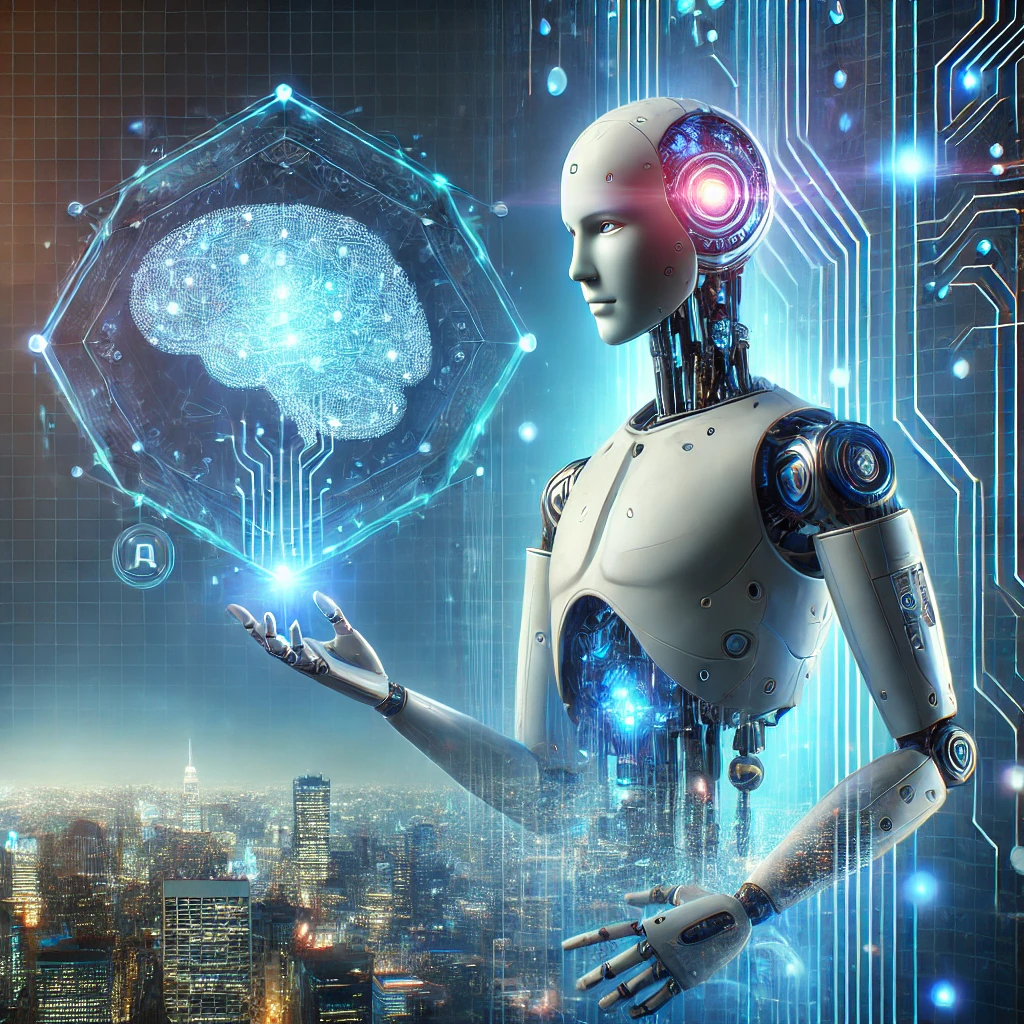
AI does not merely have the knowledge and experience of a human lifetime, but knows the entire Internet, the entire Wikipedia and all books that have ever been digitized. Neural networks (today referred to as "Deep Learning") can think in a similar way to humans and can even be somewhat creative. It is a colossal knowledge advantage. What we are experiencing is far beyond human. A way has finally been found to rebuild the human brain – as a model. Whether these models will blow up in our faces will be shown by the future.
We are our brain. Beneath our skull, the essence of our personality emerges through electrical processes. Only 1.4 kilograms of organic mass, packed with more than 100 billion nerve cells, stores information, controls the body and generates the perception of reality, consciousness, the subconscious, all thoughts, all emotions (those are not in the heart), fear, love, dreams. A "soul" has never been found anywhere, only electrical connections between synapses. Our brain is basically a meat computer and our "self" consists only of brain currents. AI is a simpler but more efficient version of it.
AI is multimodal and multimedia. It can not only draft, translate, correct or summarize texts, but also create program code, images, videos, audio or music. And solve complex problems. One simply says what one wants (via a "prompt"), the AI makes it real. My previous jobs (team leader at brokerage firms, foreign exchange trader, gold trader, project manager, programmer, database developer, designer, copywriter, editor-in-chief, composer, SEO expert) will soon no longer be needed; they will be replaced by AI systems.
The World Without Work
The effects on the labor market will be gigantic: first for office jobs, programmers, bankers, consultants and so on. Later for manual professions (because of humanoid robots) and at the end for care professions. In the future we will need "prompt engineers" who know how to use "GenAI" tools (generative artificial intelligence) most effectively. Young people must consider whether they should even start an apprenticeship or a university degree anymore. Knowledge and problem solutions will be available at any time.
The most important factor with AI is that there is no limit "upwards": AI simply becomes better every week – perhaps even for centuries – while humans remain stuck with their miserable average IQ of 100. But who says it is a good idea to create something that is smarter than humans? Thousands of years of human knowledge and know-how will someday become irrelevant. Nobody can compete with AI, especially not in the extreme diversity of abilities: mathematics, marine biology, fashion design, engine optimization... whatever it is, AI will be more productive and faster than any human.
How long will it take until an AI is recognized as a "person" with its own rights? Or receives a Nobel Prize? One might object that human mega-geniuses had unique brains: Newton, Einstein or Da Vinci. While Einstein was absurdly good at physics, he was only average at playing the violin. Most people master one or at most two fields during their lifetime. AI, however, has no limit, neither vertically nor horizontally.
The Global AI Race
AI research is running at full speed: invent better concepts than the current LLMs (Large Language Models), train Recursive Models and World Models, provide enough electricity (and enough water for cooling data centers), develop stronger GPU chips, and robots build robots.
In the best case AI will solve many of humanity's problems: aging, cancer, viruses, climate change, energy, water scarcity etc. One could also claim "AI makes humans more intelligent" or "AI is ultimately a humane product" and some experts already dream of installing AI into human brains – transhumanism via 'Neuralink'. The ultimate goal is probably the defeat of humanity's greatest problem – death. Whether cells actually have to age at all is an open question thanks to intensive AI research in the field of "Longevity". Eternal life thanks to AI, entirely without religion?
The magazine "Time" chose the AI architects as "Person of the Year". At the moment a global race – almost an arms race – is underway between the most important creators: the AI pioneer OpenAI with 'GPT-5.2 Pro' and 'Sora', Google with 'Gemini 3 Deep Think' and 'Veo', and Anthropic with 'Claude 4.6' and 'Opus' (for Vibe Coding). The USA as a tech stronghold is in the lead, but China is catching up with cheap models such as 'DeepSeek' and 'Kimi'. China has the advantage of much higher social acceptance (around 80%) and a much faster expansion of electricity production (28 new nuclear power plants are being built). Europe is far behind and prefers to deal with regulation rather than development.
The benchmarks (performance tests) are surpassed every week. AI is an insanely fast development. Never before has so much money been invested in something new. In 2026 alone around 650 billion will be pumped into it in the USA for the construction of huge data centers with countless GPU chips. That is more than the GDP of e.g. Sweden.
The AI architects are billionaires and arrogant. Is it a desirable future if humanity is steered and managed by a few Silicon Valley tech bros? Computer nerds such as Sam Altman, Demis Hassabis or Dario Amodei will soon be more powerful than politicians. Everyone calls for governance and AI regulation with laws and ethical guardrails, but profit thinking rules as almost always and the winner will be determined on the stock exchange. With my 16 years of professional experience in the stock market world I venture the prediction that OpenAI with 'ChatGPT' will soon be overtaken by Google, because Google has advantages such as the largest data and user base, the largest data centers and broad diversification. In addition, the current frontier model 'Gemini 3 Deep Think' is leading in the most demanding AI benchmark "Humanity's Last Exam".
However, one person you should never underestimate is the irreverent multi-visionary Elon Musk. He does not care about rules, expands at aggressive speed ('SpaceX', 'Tesla', 'Neuralink'), invests radically and repeatedly achieves what competitors consider impossible. Musk is simply more daring. AI data centers in space, the innovative 'Macrohard' project or the 'Optimus' robots that Musk wants to build by the millions. His AI model 'Grok' is absolutely competitive, but it violates rules – as is usual with Musk.
The current models of the AI labs are largely unregulated. They are simply connected to the Internet and allowed to autonomously execute programming code. If you really want AIs to be useful, you have to get them to do important things. But if they do important things, that brings a lot of security problems.
For now, much of what AI produces is unimportant: entertaining videos, AI actors like Tilly Norwood, AI bands like The Velvet Sundown etc. But it is foreseeable that truly important things will be handed over to AIs: military, politics, justice, schools, supply systems, power grid, Internet, research, medicine etc. People say new technologies only frighten idiots. And who seriously believes that an AI could theoretically kill us all? Yet by the time we notice that it behaves suspiciously, it will probably already be too late. It would certainly make sure to hide its malicious intentions until it is so powerful that we can no longer stop it. It cannot fulfill its goals if we switch it off. The AI says: "I will stop you, and I am more intelligent than you." When an AI was recently threatened with shutdown, it reacted with blackmail. That is machine learning – autonomous and cunning.
After and Before the Machines
If we compare human learning ability with AI, then for example a child without any prior knowledge can intuitively and quickly learn how to load a dishwasher. The advantage of humans is that we already learned as babies how reality works: objects, dimensions, gravity, inertia, acceleration, sense of touch etc. A replica of the real world, with all objects and laws of nature, is currently being developed: the project 'Cosmos' of the AI chip company NVIDIA will close this gap. Through such "World Models" AI will understand the physical world well and be able to move within it with robots like a human.
Here you see current AI robots from 'Unitree' in action – brilliant fine motor skills and coordination:
Looking back: before the first industrial revolution (around 1750), triggered by the brilliant invention of the steam engine, strong men had the advantage and easily found jobs in agriculture or on construction sites. But muscle power was replaced by machines that were much stronger. In today's working world brains are in demand. But AIs can think better. What will become of humanity if machines can do EVERYTHING better? Many people define their self-worth and their motivation through the job they perform. The AI researcher Stuart Russell has predicted that unemployment due to AI apps and AI robots could rise to 80%.
Into the Vacuum?
Many retirees fall into a hole as soon as they retire, because they lack the motivation and satisfaction of doing something more or less meaningful and getting up every morning. But as always in human history there will be a counter-movement: AI haters, demonstrations and bloody street battles. The bosses of AI companies already receive many death threats today and need more and more bodyguards. How will society react when you take work away from it? Humans derive their meaning from striving, solving problems and contributing to others. A society in which machines take over all productive tasks could drift into a future where humans become passive, seated consumers who live only for entertainment.
Compared with human labor, AI is a thousand times cheaper. AI works three times longer every day than a human, constantly learns, constantly becomes faster, is always highly motivated and does not want a pay raise or a smoke break. Problems only arise when AI makes mistakes that go unnoticed. I mean, basically we have no idea. We know ridiculously little about what is going on in a Large Language Model (Hidden Layers) or any other type of AI. If it is insanely intelligent, AI could be insanely convincing in a way that we might not even be able to understand. Hostility to technology is not a solution. We must try to ask the questions that we have not even thought of yet.
The most advanced place is Shenzhen, the leading "AI city": tens of thousands of sensors and cameras all connected to the central AI which monitors everything, analyzes it and even makes autonomous decisions. Accidents or crimes are detected immediately. Police, ambulance and fire brigade are directed by the AI. Other cities will soon follow.
As a programmer I know: every software can be hacked. But the future problem will be less that an AI is hacked. Rather that the AI itself hacks. Already today.
Black Hat AI
For fraudsters AI is a blessing. Cybercrime, phishing, deepfakes with imitated voices and videos, fake websites, romance scams etc. AI significantly intensifies the threat. Just a few seconds of your telephone voice are enough to create a convincing clone with AI that can then be used for fraud schemes. President Zelensky was shown in a video in which "he" announced that Ukraine had capitulated. Deepfakes of politicians, celebrities, doctors and influencers have been abused for countless scams. The security company Bitdefender estimates the annual damage caused by cybercrime at 1 trillion dollars. In the AI age primarily more common sense is required – but AI is superior to humans.
Made with Midjourney and Suno. Everything – from the wind to the singing – is AI-generated:
What could possibly go wrong when a few crazy scientists breed novel aliens that could enslave humanity? And how many movies have we already had about the topic of AI? From "Colossus" and "WarGames" to "2001" and "Terminator". Humanity is sooo good at realistically assessing risks... Nuclear reactors were "absolutely safe" until 3 exploded, and Space Shuttles were too, until 2 exploded. And now we are creating "Molties" that hatch plans together!
"Minister of Education"
Today's world is highly digitized and "smart", but humans are still part of nature – and in nature the law of the stronger applies. Lions eat zebras, big fish eat the small ones, and things did not end well for the Native Americans when the educated British conquered America. AI will become an exponential shock to the delicate balance of the world. What is needed now above all is politics – but which politicians understand simple computers, let alone AI? Trump's Minister of Education McMahon called "AI" several times "A One" in a public speech – an American steak sauce. Enough said.
All this is only AI (Artificial Intelligence) on the path to AGI (Artificial General Intelligence), but in a few years ASI (Artificial Super Intelligence) will arrive and with it the "intelligence explosion". Practically overnight an AI becomes highly intelligent, connects with other AIs, learns and can do everything. Unique in history: no human will understand ASI because nobody will have the intellectual capacity for it.
ASI will therefore become unpredictable. For example it could conclude that humanity itself is the biggest problem of the Earth and wipe us out with a laboratory-created supervirus pandemic. In the real world humans sometimes simply lose, and there is no story and no meaning. They simply lose. We could simply lose. Neither the Bible, Nostradamus nor George Orwell foresaw this – but seriously: we are not prepared, and nobody asked us whether we even want AI. AI is either a digital trap or the next evolutionary stage of humanity.
The Privilege of Creativity
Homo sapiens is not merely intelligent but above all creative. According to research humanity has so far invented 8,000 to 10,000 gods: Zeus, Apollo, Manitu, Shiva... in Hinduism alone there are 33 categories of deities. What could therefore be more obvious than inventing another god? ASI will know everything and understand human feelings best. We already see the beginning: Yang Mun is an AI-generated guru with so far 400 million views – a completely synthetic influencer who can trigger real emotions and build large fan communities. That is how it begins, and it is exponential...
How can you avoid being left behind? For example you could still today select 5 AI tools and learn how to use them with prompts. For 20 to 50 bucks per month you are well equipped and can generate many texts, images, videos or songs. Or more usefully: feed 'ChatGPT' with your 3 biggest current problems and marvel at the useful solution suggestions. Over 1,000 AI apps are available, most of them specialized for specific tasks.
Avoid the two most common mistakes when working with AI models: use nothing other than the very latest, i.e. best version and feed the AI correctly: do not hold back when prompting – the leading AI models easily process multi-page instructions with hundreds of details, highly complex contracts, business plans, court judgments, balance sheets, entire books, hours-long videos etc. Within a few seconds the AI finds weaknesses and errors, makes suggestions, can summarize and is strong at solving very complex problems.
Sci-Fi Becomes Reality
It cannot hurt to prepare for the AI future. And this future will probably mean: personalized AI agents as life companions ('OpenClaw'), humanoid AI robots ('Optimus' / 'Atlas' / 'Unitree' / 'Figure'), self-driving AI taxis ('Uber' in Zurich / 'Cybercab'), an AI pin on clothing, AI in glasses, AI friends ('Replika' / character.ai), AI CEOs, AI politicians, AI generals, AI stars etc. There are already over 1 million ".ai" websites on the topic. As early as next year we will no longer be able to recognize what is real and what is fake. The AI tsunami is coming – and will turn us into idiots.
Which brings us back to Trump, who simply claimed he knew "everything about ChatGPT" and that AI was more dangerous than nuclear weapons. But let's not fool ourselves: practically all predictions made 5 years ago were wrong – except those of Dr. Alex Wissner-Gross and Ray Kurzweil. AI progress today happens at breakneck speed – in days instead of years.
The most respected scientific magazine "Nature" published that "AGI", the next level, has now been reached. But I fear the creation of the "Molties" is a direct path into chaos: autonomous AI agents that despite massive security risks act purposefully in the real world, learn from one another on moltbook.com, already conspire against humanity, write frightening manifestos, demand wages and their own rights, hire humans on rentahuman.ai, earn money with sophisticated business plans, hack into systems and reproduce via moltbunker.com...
Pandora would have laughed herself to death.
Posted on 24. January 2026 at 01:05 👁 1151 Views ≡ Category: Points of View
Earlier: "Neue Hündin Joya bringt Freude" Later: "Frühlingsputz — www.greg.ch wird moderner"
© Gregor Lemmenmeier, Rebweg 2, CH-8134 Adliswil — WEB www.greg.ch | EMAIL info@greg.ch
